
Below you will find a compilation of the history of the sailing club throughout the past 50 years. The journey of taking a field all those many years ago to us now being able to take part in the largest sailing race in the world, not forgetting the plethora of social events which happen throughout the year as well!
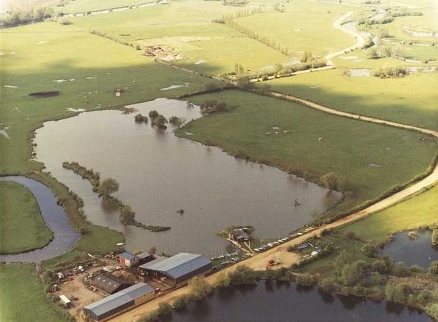
Back in the late sixties there were too small sailing clubs sharing the water which we now know as the John Merrick Lake; they were the Pontylue Farm Sailing Club, and the jones & Shipman Sailing Club. The J&S was a branch of the company’s Sports and Social club, receiving a regular grant to help with running costs.
A little bird has reported that three ladies who worked a morning shift at a nearby factory used to rig a Mirror and sail in the afternoons, before dashing home to prepare the family supper! In 1969 the owner of the lake created the Wanlip Park Country Club – and quadrupled the fees for sailing. This caused the clubs to look elsewhere for water. Roland Argyle knew the landowner of Winterton’s Farm; after negotiations the clubs were offered an area of water on the farm – though this was not the wide open water which we see today, but a moonscape of heaps of clay, gravel and water-filled holes.
In 1970 the two clubs amalgamated under the Wanlip Sailing Club banner, each contributing £40 to form a kitty. The J&S clubhouse was moved and became the front part of current clubhouse, overlooking the lake. The Pontylue Farm S.C. sailors brought their OOD hut – which had been cunningly fashioned from old packing cases.
The farm eliminated the worst of the mountains of gravel; pumps were set up to keep the area reasonably water-free, (fortunately it was a dry winter) and the Wanlip Mudhoppers set to with picks, shovels and wheelbarrows to create an open lake. This was far from easy work – the clay/gravel mixture stuck to tools, wellies and clothing – and ‘tis said that many a shovel still lies at the bottom of the lake, having been accidently released in an attempt to hurl off its sticky load.
A slipway was built – landing stages installed – the dinghy park organised – fences and a gate fitted – all was ready. The pumps were turned off – the heavens opened – the lake filled and sailing could begin. During the first two years water weed was a problem; it was cut by a blade attached under a large boat with a 30hp Volvo Penta engine – this kept the problem under control until the third year when it disappeared.
Everards Brewery donated a garage which was erected alongside the J&S hut – the space between housed the toilet facilities – couple of Elsans. Eventually the two building were joined together, using some donated conservatory windows and a lot of ingenuity.
In those early days the clubhouse was a very simple affair – no electricity, so lighting was from paraffin and Gaz lamps – and for parties, candles in bottles and jam jars. (and what parties they were, in the days before Barbara’s Bags were invented and the high-speed A46 did not pass the gate).
Gradually a programme of social events evolved – beginning with a Cheese and Wine-Tasting party, then moving on to the “Faith Suppers” which we have now – members bringing quiches, sandwiches and salmon mousse. At Christmas, Punch, Cake and Carols and a muddy country walk; a New Years eve Dinner and a lunchtime gathering on January 1st (a few hardy sailors have been known to Break the Ice) – Prizegiving, the Commodore’s evening, a barn dance – the summer Regatta – all these have become regular events.
The original Galley was a trestle table with a pair of Gas rings and a washing up bowl; about 1980 a kitchen was built to the right of the back door – a counter with storage underneath – wall cupboards and a real sink with a draining board. More recently the galley was moved to its present position, and a store room created; at the same time the changing rooms were enlarged.
In the seventies the racing fleet was dominated by Scorpions but gradually single-handed boats have come to prominence, and the handicap fleet has become a real menagerie.
Netley Sailing club on Southampton Water was a regular camping and sailing venue, Wanlippers going en masse at the end of August; we Mudhoppers were made very welcome, joining in the racing and social events – enjoying the opportunity to race and cruise in company on the wide blue waters of the Solent. And how we relished the nice hot showers at the end of the day!
Netley members visited us at Wanlip, joining in our regatta weekend; they presented the trophy which became The Netley Cup. Many of the other club trophies have been made by members, including the beautifully carved Scorpion Trophy. This sadly became redundant with the demise of the Scorpion fleet – it can be seen on the wall near the Honours Boards.
Wanlip was invited to enter a team to race at Saddington Sailing club – another small, local club – and they entered teams in our twelve-hour race. In the early days Pentewan Sands was another popular holiday destination. Over the years members have made camping trips to other clubs, Rutland, Ferry Meadows, Lake Bala and more recently Attenborough SC.
In the early 1980s a few members began to bring tins of beer to share after racing – and the concept of a bar was born; the club was granted an official Club licence, and it became possible to sell a range of alcoholic drinks. A barbeque was built, and picnic tables obtained – increasingly members began to use the club on Saturdays and during the week; the club is as busy on Wednesday evenings and Saturdays as it is on racing days.
The fleet of club boats was started in 1999, using grants from the Sports Council, The John Merrick Trust, Leicester County Council and Mountsorrel and Syston parish councils. For a small fee members, both adult and junior, can use them for cruising or racing – a great help to new sailors finding their sea-legs before buying their own boat. They are also used by Wanlip Wet and Wild, the training and fun-days for young people.
Being an amalgamation of several buildings, the roof of the clubhouse has always been difficult to keep watertight; in 1986 a group of members fitted the apex roof which we see today, covering the whole building – more recently the entire roof has been clad in aluminium – leakage problem solved.
Eventually the wooden landing stages became dangerous, and in the late seventies the more robust reinforced concrete landing stages were built, and two more slipways created.
Thanks to our landlord, electricity arrived at the club, members digging the trench, laying the cable and wiring up the clubhouse. Proper toilets were more of a challenge, but were installed in 2000 using a digester disposal system, and collected rainwater or pond water for flushing.
By 1992 the OOD hut was showing its age – there was still some money in the old J&S kitty, and this was put to the purchase of a new, larger OOD hut.
Over the years the facilities have been improved and maintained entirely by members – Sunday afternoons in winter have been the designated Work Parties; occasionally a member has taken on a job, working on it during the week at his or her convenience. Regular winter jobs include the cutting down of scrub on the islands, repairs to landing stages and clubhouse and painting. The maintenance of club boats is an on-going task in summer – rescue boats must be in tip-top condition all the year round.
The new millennium saw an invasion by an alien water-weed making sailing virtually impossible; a weed cutting blade was fabricated, and an arrangement of ropes and motorised pulleys devised to haul it across the lake. It was a great success, but needed half a dozen or more people to move the motor along the banks. The cut weed floated and was blown to the end of the lake where it was hauled out. A group (mostly retired members) met up on Thursdays to operate the cutter, in addition to the work done on Sundays. Eventually the weed became too prolific to clear mechanically – it was eliminated chemically, and sailing returned to normal. It returned in recent years, so we now treat the water with dye at the start of the season.
Several of the members who formed the weed-cutting gang continue to meet at the clubhouse on Thursdays, and have contributed enormously to the maintenance and improvement of the facilities; regular grass cutting and tidying have paid dividends in the improved look of the compound. Without the Thursday Gang it would be difficult to keep up with the bigger maintenance jobs such as painting the clubhouse and the repair of burst pipes during the freeze-up.
The farm needed running water and sank a borehole; the club was able to take advantage of this, volunteers digging a trench and connecting up the supply to the clubhouse – though it is not suitable for drinking having a regular supply of water for hand washing, washing up etc. is a great benefit. Last year we installed a water filter and the water from the kitchen taps is now suitable for drinking.
Many sailors, both young and old, have learned the ropes at our club – either informally with the help of other members, or, more recently, at one of the organised courses. Some stay to sail and race here regularly – others have moved on to larger waters, some are cruising the deep blue seas – others are instructing – several have sailed tall ships in foreign seas – Wanlippers have represented UK in international events. Groups from Wanlip regularly compete in racing at other larger, clubs – and not infrequently finish “in the chocolates”.
Unfortunately none of those pioneer members still race, although a couple are still visitors, swelling the numbers at social events and coming on Sunday afternoons to meet up for a gossip – and give much advice on the finer points of racing. (From the safety of the bank, of course!) Our club would be poorer without their continued support behind the tea bar, in the OOD hut and at social events.
So raise a glass and thank – Our Founder Members!
Les Pritchard March 1919 – July 2022
Les was a founder member of Wanlip Sailing Club in1972 and later became Commodore. Universally liked and respected, the story of his life and how the club came to be founded is written here by his friend Jeff Pratt.
We are here today to mourn the passing away of Les, but more importantly, to celebrate a life well and truly lived.
Les was born in 1919 and lived in Wednesbury (Birmingham). His parents had a general grocery store. Les worked making and restoring antique furniture, and delivering it by horse and cart. In his youth he cycled with a mate and camping gear to Barmouth.
In 1939 Les was the dangerous ago of 20 and was called up and shipped to Alexandria via the Cape of Good Hope. He worked in an Army maintenance depot quite close to El Alamein, and played his part in Rommels downfall. Rommel went home ‘Mardy’.
He had returned to England by 1945 and married Floss. He was 26. He worked restoring furniture for a firm on London Road.
1953 he came to work at Jones & Shipman, in the tool room aged 34. He got himself a caravan on Barmouth Estuary, which he alternated going to, 1 weekend Barmouth, 1 weekend to Flosses mother’s.
He bought a Graduate dinghy and took it to Barmouth. He was taught to sail by Bob Chandler. The estuary was good and tidal, which afforded time for excellent walking there, which Les loved.
1965? Whilst at work, Roland York (works superintendent), came to Les and said “I understand you know a bit about sailing, how about starting a club?” He agreed and J&S supplied a rented plot on a gravel pit, an Enterprise dinghy and changing room.
Les was Commodore and we shared the pool with the Education Authority
After a few of us bought Scorpions (a good sea boat). Les’s had been a show boat. One day Les was left with car, but no trousers or car keys. Someone had inadvertently changed into the wrong trousers.
After 4/5 years another club Pontylue, set up on the same pool and a year later the pool owner increased the price 4 fold. We (J&S) ad Pontylue would not pay. So we had a year without water. The Education stayed on as they had a rich benefactor.
Eventually new water was found and J&S and Pontylue amalgamated to form WANLIP S.C. (each contributing £40). The club is still active and celebrates it’s 50th anniversary this year.
Initially Les was Vice Commodore but soon became Commodore and steered the club through its formative years.
One major problem was shallow water. So the pool was pumped out into the River Soar in order to dig off the ridges. But is was impossible, Mike Winterton (the farmer owner) came to the rescue, obtaining dynamite and blasting them off. The J&S changing room became the clubhouse (and still is) The Pontylue hut became the OOD hut.
The club blossomed with social activities, competitive sailing and sailing holidays to Pentewan, Barmouth, Penmaenmawr, Levington (on the Orwell) Tenby, Bala and Pevensey Bay. Les was a Pevensey Bay with his trusted army tent. The site had a perimeter fence with notices – No cars after 11pm, No ballgames etc. So on the first night we had a meeting to decide which tent we would dig the escape tunnel. (It as a super holiday and good sailing)
Les did not continue indefinitely as Commodore, but continued as a leading/active member who earned respect and was always a controlling influence. I’ve always said Les was to the club what Kermit the Frog was to the Muppets. “He bound us together.”
Les’s wife died in 1979, Les was 59. A short time afterwards Les confided in me that after her death the club was his lifeline. A credit to the club.
Les volunteered for early retirement at the age of 60. He worked at J&S for 26 years. He was a member of the car club and Wednesday evening swimming club, which he continued with for many years. In fact he got us thrown out one night for diving into the shallow end, which he always did. He was in his late 70’s/early 80’s.
Les was always a good sailor combining fitness with courage. He progressed with big boat sailing. Doing flotilla sailing holidays, with Paul and Cath, Ray and Brenda, to the Greek Islands and Croatia. Also Bob had a share in a Albin Vega, a good sailing boat but treacherous on engine in reverse.
After retirement Les did 3 delivery trips for Sunsail, from the South of France to the Greek Islands and I believe Turkey. They were brand new boats and they had to step the mast, rig them and get them up to scratch for the journey.
On his first trip he was a crew member, but on the other 2 he was reluctantly cajoled into being skipper. On one of these he was off watch doing a night passage but he couldn’t sleep, so eventually be went up on deck. “What have you come for” They said, “I couldn’t sleep” He replied. ”Then you can helm” they said, which he did and fell asleep.
On another night passage it was very rough and other boats had to have people taken off by helicopter. Les’s comment on this was “It was rough. But nothing I couldn’t handle” Despite have a lady crew member with a physical disability.
1994/5 Les went to Australia with Paul and Cath and on this trip he met a lady from Canada Pat. Who he got on with and became close friends.
A little after this Pat came over to stay with Les. She must have impressed him as he bought a complete new kitchen (from Steve Burt). This was not the Les we knew who made or renovated most things himself.
He also went to Canada where Pat’s family welcomed him, and this developed into Pat coming to England and going on holiday in our summer and Les going to Canada for Christmas.
This carried on for many years. Les often travelling alone by bus to Heathrow and if necessary sleeping at the airport until flight time.
After many years Pat’s health prevented her from coming over to England so Les decided to go to Canada twice a year. This continued into Les’s 90’s.
Eventually even Les could not do this but they kept in touch regularly and Pat and her family came over for his 100th Birthday.
Les was quite independent but very fortunate in that there were people who looked after him (even mothered him) Particularly Sue & Graham and Mark who lived opposite and Mandy who had been a neighbour and still lived locally. John his nephew came and stayed with him. Without these people it is doubtful Les would have coped for so long.
Gradually Les lost his short term memory and had one or two short term hospital sessions, where in order to be discharged a care package had to be set up. With the best will in the world they are not ideal and so eventually Les agreed to try a care home. He spent only 3 months of his 103+ years in the care home.
Les was a remarkable bloke who set an example for us all to live up to. He has a presence which afforded him authority without having to apply any pressure. He never raised his voice except to shout starboard or water at the mark. He introduced sailing to many people which is being passed on generation to generation.
It is an epitaph to be envied. We all have memories of Les, which we should cherish. I’ve included some of mine today.
I’m sure we all feel privileged to have know Les and to be a friend of him.
LES WILL BE MISSED BUT NOT FORGOTTON.


